


Tours Day Trip: Musée des Beaux-Arts & Cathedral Guide


Tours in Half a Day: Musée des Beaux-Arts, Saint-Gatien Cathedral & The Hidden Cloister
While Tours is celebrated as the primary transit hub and hotel base for exploring the grand châteaux of the Loire Valley, the city itself holds fantastic cultural depth right in its historic centre.
Before catching an afternoon train out to Amboise, I spent a relaxed summer morning exploring two of the city's most significant heritage landmarks: the Musée des Beaux-Arts de Tours and the monumental Cathédrale Saint-Gatien.
Because the former Archbishop’s Palace and the cathedral share the exact same cobblestone quarter, they sit literally a stone's throw apart. You waste zero time in transit, making it effortless to link both together into a calm, culture-rich morning.
Here is my honest breakdown of visiting both sites, what to look for inside, and why paying a little extra to step into the cathedral cloister is an absolute must.

This site contains affiliate links to products. I may receive a small commission for purchases made through these links, at no extra cost to you.
Musée des Beaux-Arts de Tours: An Archbishop’s Palace & A Giant Cedar
Your visit naturally begins by passing through the monumental neoclassical entrance gate on Place François Sicard.
The museum is housed within the grand Palais des Archevêques (Archbishop’s Palace), an architectural complex blending ancient Gallo-Roman perimeter walls, medieval rampart stones, and stately 17th- and 18th-century reception wings.

The Courtyard, The Cedar & Fritz the Elephant
Before stepping inside to buy your ticket, take time to wander the courtyard gardens:
The Monumental Cedar of Lebanon: Dominating the front courtyard is a colossal Cedar of Lebanon (Cedrus libani). Planted in 1804 under the Napoleonic era, its sweeping branches cover over 600 square metres. Standing beneath its shady canopy is awe-inspiring, and it officially holds the "Arbre Remarquable de France" heritage label.
Fritz the Elephant: Tucked into an enclosed glass pavilion in the outer courtyard sits one of Tours' quirkiest local legends: Fritz. Fritz was a massive Asian circus elephant travelling with the American Barnum & Bailey Circus in 1902. When he became aggressive during their French tour, he was sadly euthanized, after which his taxidermy mount was preserved and gifted to the city. Seeing him up close right beside formal French palace gardens is an unexpected sight.
The French Formal Gardens: Around the south side of the palace, you will find manicured French parterre lawns lined with spherical boxwood topiaries, bright seasonal flowerbeds, and quiet shaded benches overlooking the stone balustrades.
Exploring the Museum Galleries
To be fair, this museum does not have the massive, jaw-dropping scale of the Palais des Beaux-Arts in Lille, but it is still a deeply rewarding, well-preserved regional collection that easily commands an hour or more of your morning.
The layout leads you across multiple floors linked by a magnificent curved wooden staircase with wrought-iron railings beneath a grand chandelier:
Archepiscopal Salons: Several of the state rooms retain their historic silk damask wall coverings—ranging from deep crimson to soft pastel greens and lilacs. They are furnished with 18th-century gilded mirrors, console tables, and an intricate marble fireplace.
Renaissance & Classical Masters: The galleries showcase exceptional works, including precious Italian Renaissance panels by Andrea Mantegna, Dutch masters, and French salon canvases. A standout piece on display is an immense, intricately inlaid Florentine marble and hardstone tabletop (pietra dura) covered in detailed floral scrollwork.
Modern & 20th-Century Art: Moving into the upper wings, the collection broadens into modern portraits and expressive figurative art from the early 20th century, such as expressive portrait work by Marcel Gromaire.
I paid €8.40 for a standard adult admission when I visited in June. It is very affordable, well-curated, and directly supports the preservation of the historic palace complex.
Cathédrale Saint-Gatien de Tours: Gothic Splendour & Stained Glass
Exiting the museum courtyard, a two-minute stroll across Rue Lavoisier brings you directly before the west front of Cathédrale Saint-Gatien.
Built in stages between the 13th and 16th centuries, the cathedral illustrates a textbook evolution from classical High Gothic into intricate, lace-like Flamboyant Gothic, topped by Renaissance stone lantern caps on its twin towers rising nearly 70 metres high.
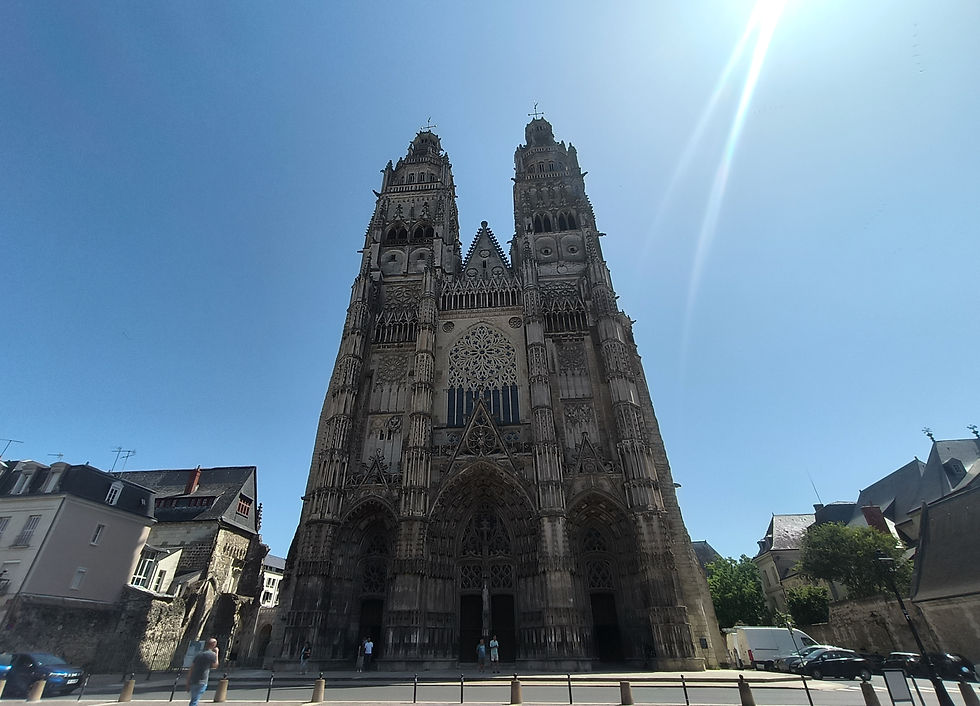
Inside the Cathedral
Entry into the cathedral nave is completely free of charge. Stepping inside, the vertical scale hits you immediately:
Soaring Stone Vaults: The central nave stretches 100 metres in length beneath vaulted ceilings soaring 29 metres overhead. Long, arched side aisles flanked by deep stonework pillars lead toward the radiating ambulatory chapels.
Medieval Stained Glass: Tours Cathedral holds some of the finest 13th-century stained-glass medallion windows in central France. Even in the lower side chapels, radiant stained-glass lancets cast brilliant blue and crimson reflections across the aged stone walls and alterpieces.
The Renaissance Organ: Suspended high on the wall of the south transept is the magnificent Renaissance pipe organ casing. Carved from dark oak with intricate relief woodwork and tall polished metal pipes, it stands out against the rose window above.
The Secret Highlight: Cloître de la Psalette
While anyone can walk into the cathedral nave for free, the real hidden treasure sits tucked away along the north flank: the Cloître de la Psalette.
Access to the cloister requires a separate ticket (run via the Centre des Monuments Nationaux, usually costing around €6 to €7), but I highly, highly recommend paying the extra fee. It was easily one of the most memorable parts of the entire morning.
Named "La Psalette" because it originally served as the singing school and library where the cathedral choir boys rehearsed their psalms, this secluded space feels like stepping back into the early 1500s:
The Peaceful Courtyard: The cloister surrounds an open, sunlit central lawn garden lined with stone paths. Looking straight up from the courtyard benches gives you an unbelievable, close-up perspective of the cathedral's intricate flying buttresses, gargoyles, and Gothic roof pinnacles.
Vaulted Stone Walkways: The galleries feature elegant rib-vaulted corridors lined with carved keystones and historic stone fragments salvaged from centuries of cathedral restorations.
The Renaissance Spiral Staircase & Upper Terrace: The standout architectural gem is the open-work Renaissance spiral staircase (escalier à vis). Climbing up brings you onto the upper stone balcony balustrade, complete with sweeping open-air views looking straight into the flying buttress arches and the soaring cathedral towers above.
The Canon's Library: Tucked into the upper chambers, you can also admire small stained-glass window panes set into wooden shutters, depicting vibrant geometric and maritime emblems.

Practical Info & Planning Advice
Musée des Beaux-Arts Tickets: Adult admission sits around €8.40 (concessions available), which covers the palace interiors and temporary exhibitions. Access to the outer courtyard to see the Cedar of Lebanon and Fritz is open to the public during garden hours.
Cathedral & Cloister Entry: The main cathedral nave is free to enter year-round. The Cloître de la Psalette is a paid monument open daily (typically 9:30 am to 12:30 pm, and 2:00 pm to 6:00 pm, slightly reduced in winter).
Realistic Pacing: You can comfortably do both in half a day. Budget at least a solid hour for the museum galleries and gardens, and at least another full hour to take in the cathedral nave and explore the cloister walkways. If you love examining fine art labels or lingering on the upper cloister terrace with a camera, allow 2.5 to 3 hours total.
Crowds: I visited on an early summer morning in June, and neither site was crowded. It offered a peaceful, contemplative atmosphere that felt completely worlds away from the tour-bus congestion of the Loire's most famous châteaux.
Final Verdict: Are They Worth Visiting?
If you have a morning or afternoon to spare in Tours, visiting both the Musée des Beaux-Arts and Cathédrale Saint-Gatien is well worth your time.
They offer a perfect pair: an elegant former palace rich in regional art, followed by one of northern France’s greatest Gothic monuments and an unforgettable Renaissance cloister garden. It gives you a genuine appreciation for Tours' own historic identity before you hop on the train to tour the royal châteaux downstream.
If you found this helpful and would like to support the blog, you can buy me a coffee here. Every little bit helps keep my reviews, guides, and recipes completely independent!
Have you visited the Musée des Beaux-Arts in Tours or walked the upper terrace at the Cloître de la Psalette? Let me know your travel experiences in the comments below!
I hope life is treating you well.
Take care


