


Osu Kannon Temple Nagoya Review: A Buzzing Buddhist Sanctuary on a Shinkansen Layover


Osu Kannon Temple Nagoya Review: Giant Red Lanterns & Shinkansen Layover Guide
When travelling by Shinkansen from Tokyo toward Kyoto, it is tempting to speed straight through central Japan without getting off the train. On a day trip in late March, I decided to break up the journey by making a targeted stop in Nagoya.
My morning was spent exploring the sprawling grounds and golden shachihoko of Nagoya Castle, after which I continued across the city centre to visit Osu Kannon (大須観音).
It was a shortish, low-pressure visit—I spent maybe 30 to 40 minutes paying my respects, walking the courtyards, and soaking in the lively neighbourhood atmosphere before hopping back on the bullet train to Kyoto.
Even on an overcast spring afternoon, the vibrant vermilion structures and neighbourhood energy made it a memorable stop. Here is my honest review of visiting Osu Kannon Temple, what to see on the grounds, and practical advice for fitting it into your transit day.

This site contains affiliate links to products. I may receive a small commission for purchases made through these links, at no extra cost to you.
The Backstory: From Mino Province to Nagoya's Merchant Core
Officially named Kitanosan Shimpuku-ji Hosho-in, Osu Kannon is a Buddhist temple belonging to the Shingon sect, dedicated to Kannon, the Goddess of Mercy.
Founded in 1333: The original temple was built in neighbouring Gifu (then Mino Province) by Emperor Go-Daigo.
Relocated by Tokugawa Ieyasu: Due to repeated flooding, the great unifier Tokugawa Ieyasu had the entire complex relocated to its present site in Nagoya in 1612. The thriving merchant district of Osu grew up entirely around the temple gates to serve the steady flow of pilgrims.
A Precious Library: Beneath the main halls lies a legendary cultural treasure trove: the Shinpukuji Bunko, an ancient library containing roughly 15,000 historic Japanese and Chinese texts, including the oldest surviving handwritten manuscript copy of the Kojiki (Japan’s ancient mythological chronicle) dating back to 1371.

The Visit: Incense Smoke, Giant Lanterns & Stone Steps
Arriving in the plaza, the contrast between the historic temple and the surrounding modern city buildings is immediate:
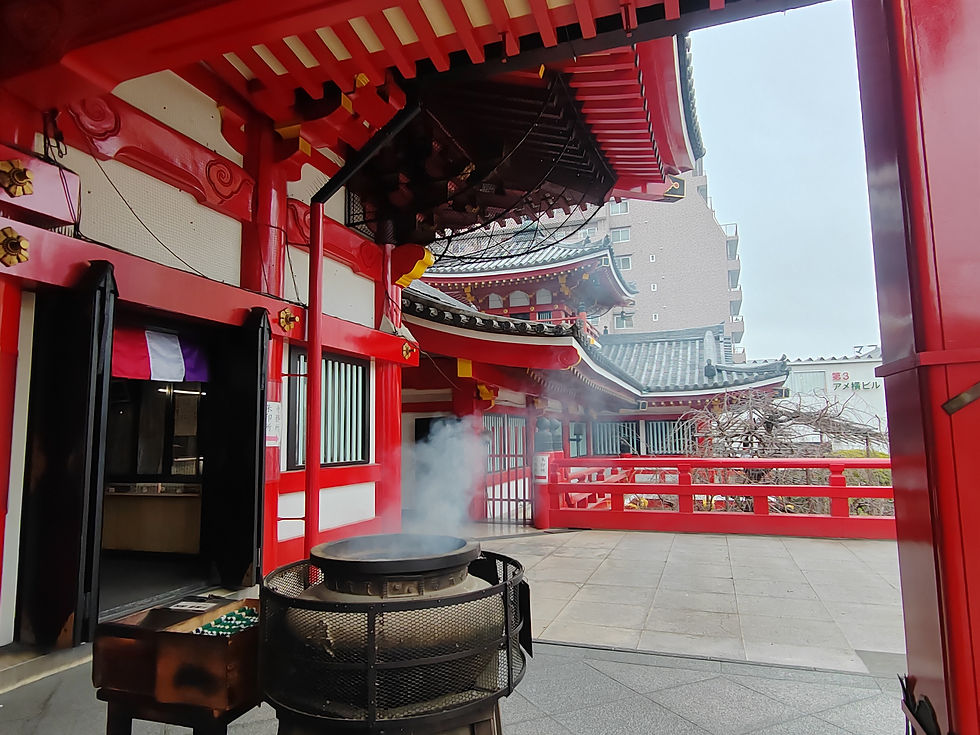
The Grand Stone Staircase: Wide stone stairs flanked by white and red prayer banners lead straight up to the raised main hall (Hondo). Looking up from the base, the multi-tiered eaves, curved gables, and bright red railings dominate the square.
The Giant Paper Lantern (Chochin): Hanging directly under the eaves of the worship hall is a massive, crimson paper lantern. Underneath, intricate gold-and-black woodwork depicts swirling ocean waves, giving it a dramatic scale similar to the famous lantern at Senso-ji in Tokyo.
Cleansing Incense (Jokoro): In the upper courtyard sits a large iron incense burner billowing aromatic smoke. Visitors and worshippers gather around to wave the fragrant white smoke over their heads and shoulders, a traditional ritual believed to impart healing, good health, and clarity of mind.
The Bell Tower & Spring Blooms: Down in the courtyard stands the wooden belfry (Shoro), housing the massive bronze "Bell of the Mother." Visiting in late March brought blooming white and pale pink cherry blossoms beside the temple side gates, contrasting against the brilliant vermilion paint.

The Buzz: Seamless Transition into Osu Shopping Street
What makes Osu Kannon special is how seamlessly spiritual worship blends into daily city life.
Right outside the temple boundary stands the entrance to the Osu Shopping District (大須商店街). Spanning over 1,200 shops, vintage clothing boutiques, electronics stalls, street food vendors, and traditional tea merchants across covered pedestrian arcades, the area has an unmistakable buzz. Even if you only have an extra 15 minutes, walking beneath the giant torii banners and vibrant arcade murals right off the temple grounds is worth it.
Practical Info: Getting There & Layover Advice
Address: 2-21-47 Osu, Naka Ward, Nagoya, Aichi 460-0011, Japan.
Admission: Completely free to explore the temple grounds and outer courtyards.
Opening Hours: The temple grounds remain open 24/7; the temple main hall and amulet counters generally operate from 9:00 AM to 5:00 PM.
Getting There:
Take the Nagoya City Subway Tsurumai Line directly to Osu Kannon Station (Exit 2). The temple sits just outside the station exit.
From Nagoya Station (Shinkansen stop): Take the Higashiyama Line to Fushimi Station, then transfer to the Tsurumai Line for one stop to Osu Kannon Station (around 10 minutes total).

How to Fit It Into a Tokyo-to-Kyoto Transit Day
Nagoya is the perfect halfway layover on the Tokaido Shinkansen:
Store your luggage in the coin lockers at JR Nagoya Station.
Spend 1.5 to 2 hours exploring the castle grounds and palace reconstruction at Nagoya Castle.
Take the subway south to spend 30 to 40 minutes at Osu Kannon and sample local street food in the arcades.
Head back to Nagoya Station to catch the 35-minute Shinkansen onward to Kyoto.
Final Verdict: Is It Worth It?
If you are already in Nagoya or looking to break up a long train ride across central Japan, Osu Kannon is well worth the detour. It requires very little time, costs nothing to visit, offers grand Buddhist architecture with dramatic photo angles, and dumps you directly into one of the liveliest retro shopping districts in Japan.
Have you visited Osu Kannon or stopped off in Nagoya during a Shinkansen journey? What were your impressions of the temple and arcades? Let me know in the comments below!
I hope life is treating you well.
Take care

